
Here’s something arborists don’t often tell homeowners:
That tree that fell during last year’s storm? The one that crashed through your neighbor’s roof?
It didn’t fail because of the storm.
It failed 15 years ago — when someone made a single pruning mistake on a young tree.
Let me explain.
Why “Old Tree Problems” Are Actually Young Tree Mistakes
Walk through any neighborhood in Singapore and you’ll see them:
- Trees leaning at dangerous angles
- Codominant stems splitting apart
- Crowns so unbalanced they look ready to topple
- Branches with weak attachments just waiting for the next thunderstorm
Ask any property manager what caused these problems and they’ll say:
“The tree is old.”
“It wasn’t maintained properly.”
“We need better pruning.”
They’re all wrong.
The real answer?
These problems were baked in during the first year after planting.
The Critical Window: Year One
Think about how a tree grows.
Unlike buildings that are constructed from the ground up, trees build from the inside out and the top up.
That branch structure you establish in Year 1? It becomes the permanent framework the tree builds upon for the next 50+ years.
Get it right early = strong, stable, long-lived tree
Get it wrong early = expensive problems guaranteed
It’s that simple.
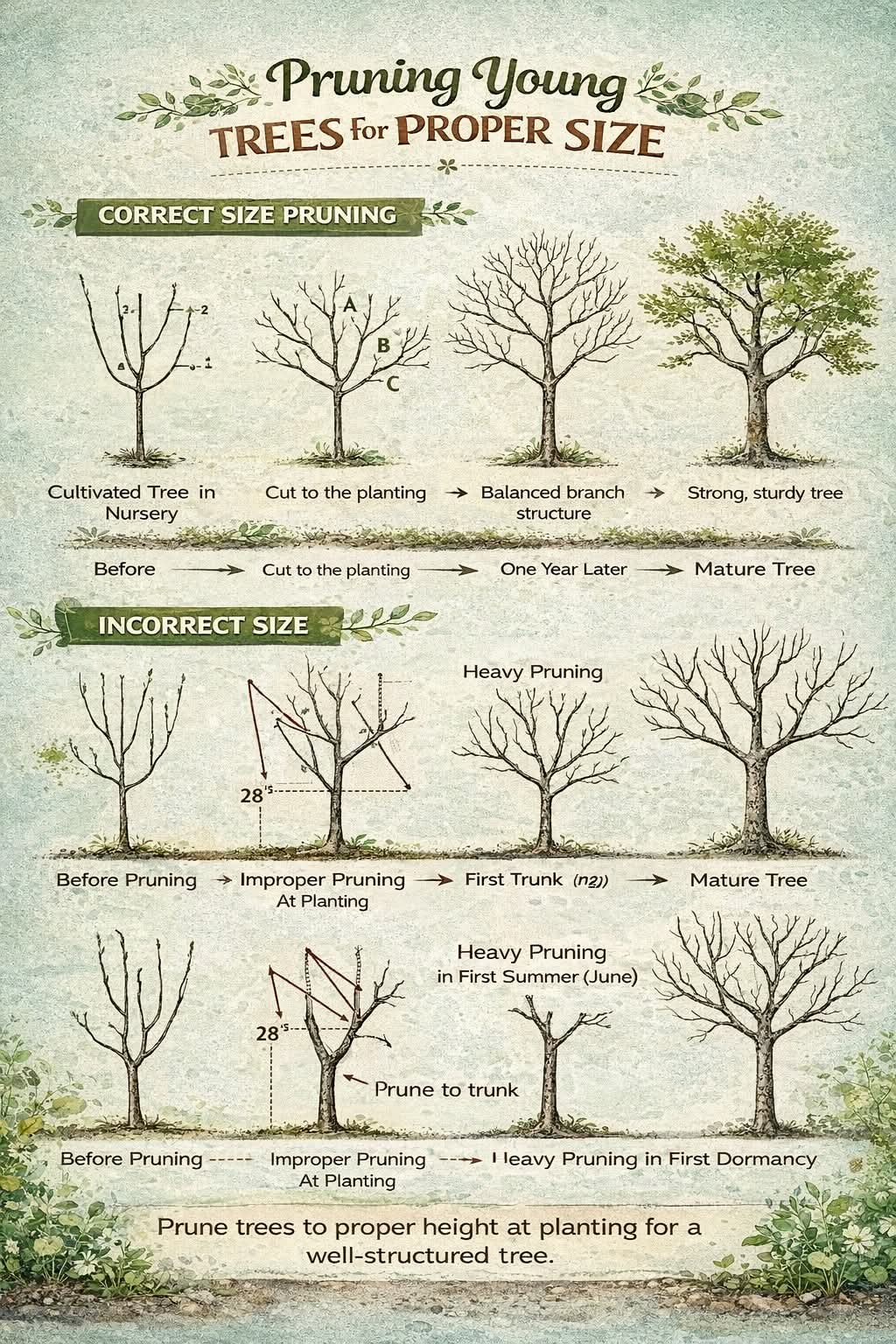
What Happens When You Prune Young Trees Correctly
✅ The Smart Approach: Structural Training
When you prune strategically during the first growing season:
1. Strong Central Leader Develops
- One dominant trunk grows straight and tall
- Side branches remain subordinate
- The tree develops the classic “Christmas tree” structure
- Foundation for long-term stability is set
2. Balanced Branch Spacing
- Branches emerge at regular intervals
- No two branches compete for the same space
- Each branch has room to develop properly
- Natural spacing prevents future crowding
3. Proper Branch Angles
- Branches attach at 45-60 degree angles (strongest attachment)
- No “V” crotches that will split under load
- Branch collars develop properly
- Aspect ratios stay under 50% (SS 724 compliant)
4. Easier Long-Term Management
- Less pruning needed as the tree matures
- Predictable growth pattern
- Lower maintenance costs
- Reduced risk of failure
The Result?
A tree that’s set up to thrive for 50+ years with minimal intervention.
What Happens When You Get It Wrong
❌ The Common Mistake: Neglect or Over-Pruning
Scenario 1: “Let Nature Take Its Course”
“Trees grow in the wild without pruning, so why should I prune mine?”
Here’s why:
Wild trees grow in forests with competition. Only the strongest survive. The weak ones die.
Your landscape tree doesn’t have that luxury. It’s:
- Growing in isolation (no competition to force upright growth)
- In compacted urban soil (not forest soil)
- Expected to never fail (no acceptable risk tolerance)
- Required to fit specific space constraints
Without early training:
- Multiple leaders compete for dominance
- Branches grow at awkward angles
- Structure becomes unbalanced
- Future failure is almost guaranteed
Good Post
ok