
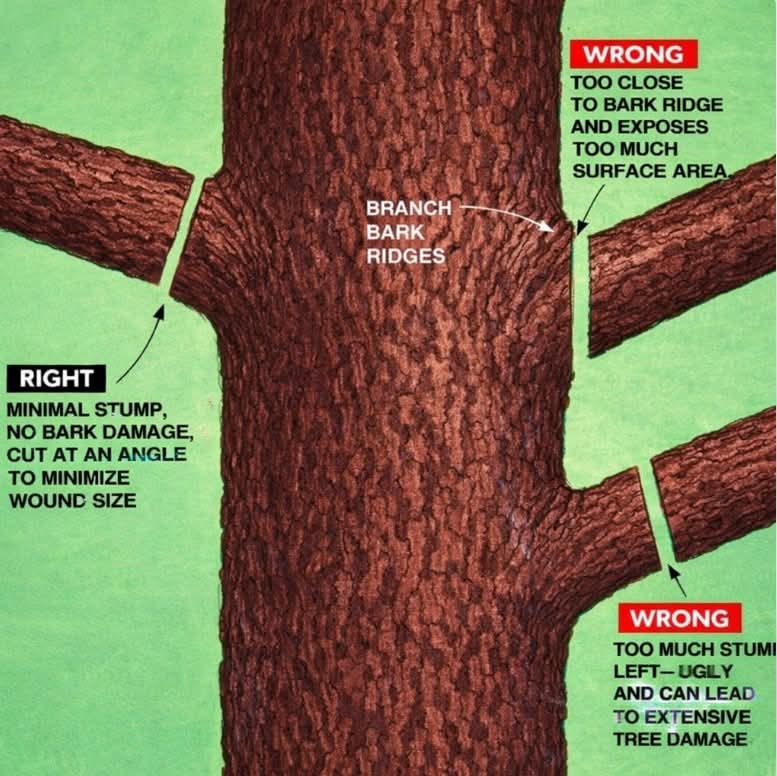
The Anatomy of Tree Murder (Unintentional, Of Course)
Let me show you exactly how people accidentally destroy their trees:
❌ WRONG CUT #1: The “Flush Cut” (Tree Killer)
What it looks like: Cut made completely flush against the trunk, leaving a smooth surface
Why it’s deadly:
- You’ve just cut through the branch collar — the tree’s natural defense system
- Removed the protective tissue that seals wounds and fights decay
- Created a direct pathway for rot to enter the main trunk
- The tree can’t compartmentalize the wound properly
The result: Decay spreads into the trunk. Years later, the entire tree becomes structurally compromised. Your “clean” cut just cost you a $5,000 tree removal job.
❌ WRONG CUT #2: The “Stub Special” (Rot Magnet)
What it looks like: A long stub of branch left sticking out several inches from the trunk
Why it’s deadly:
- The stub has no living tissue to draw nutrients
- It becomes dead wood still attached to a living tree
- Perfect entry point for fungi, bacteria, and insects
- Eventually rots back to the trunk anyway — but now the decay is deeper
The result: That stub you left? It’s literally a signpost saying “Disease Welcome Here.” The rot will work its way back to the main trunk, causing way more damage than if you’d cut it properly in the first place.
✅ THE CORRECT CUT: The “Goldilocks Zone”
What it looks like: Cut made just outside the branch collar, at a slight angle following the natural ridge
Why it works:
- Preserves the branch collar — nature’s wound-sealing tissue
- Minimal wound size
- Tree can properly compartmentalize and seal the cut
- Follows the tree’s natural defense mechanisms
The result: The tree seals the wound efficiently, stays healthy, and continues thriving for decades.
Here’s What Most People Don’t Understand
Trees don’t heal like humans.
When you cut yourself, your body regenerates tissue and the wound closes.
When you cut a tree, it doesn’t “heal” — it SEALS.
The tree walls off the damaged area with specialized tissue, compartmentalizing the wound to prevent decay from spreading to healthy wood.
This process is called CODIT (Compartmentalization of Decay in Trees) — and it’s why pruning technique matters so much.
Bad Cut = Bigger Wound = Failed Compartmentalization = Decay Wins
It’s that simple.
The Three Golden Rules of Pruning (Singapore SS 724 Compliant)
Rule #1: Don’t Cut Flush to the Trunk
Find the branch collar (that slightly swollen area where the branch meets the trunk) and cut just outside of it. Never cut into it.
Rule #2: Don’t Leave a Long Stub
Cut close enough that there’s no dead stub left to rot, but not so close that you damage the collar. Aim for 1-3cm from the branch bark ridge.
Rule #3: Follow the Natural Branch Collar
Look for the branch bark ridge (the raised line of bark between branch and trunk). Your cut should be angled slightly away from the trunk, following this natural line.
Real-World Consequences of Bad Pruning
Let me paint you a picture of what happens when pruning goes wrong:
Year 1 After Bad Cut:
- Tree looks fine
- Small wound visible
- “Everything seems okay”
Year 2-3:
- Wound hasn’t closed
- Bark starts cracking around the cut
- You notice some discoloration
Year 4-5:
- Fungal growth appears
- Wood around cut is soft and spongy
- Branch above the cut starts dying back
Year 7-10:
- Major structural decay
- Arborist tells you the tree is now a safety hazard
- Options: expensive cable system ($2,000-$5,000) or complete removal ($3,000-$8,000)
All because of one wrong cut.